
Typical Weekly Services
Sunday
09:30 Mass at St. Columba's
11:00
Mass at St. John's
Monday
19:00 Mass at St Columba's
Tuesday
12:15 Mass at St. Columba's
19:00 Mass at St. John's
Thursday
12:15 Mass at St. Columba's
10:00 Mass at St. John's
Friday
10:45 Mass at St Columba's
Saturday
09:30

Mass at St. Columba's


Weekly Bulletin

Welcome

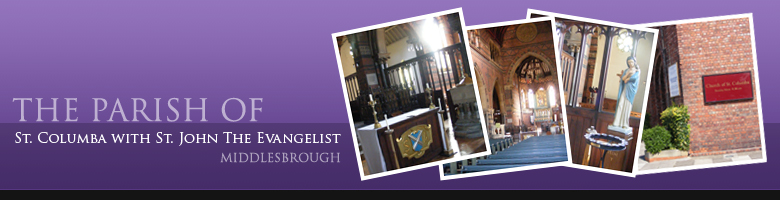
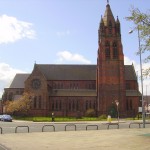
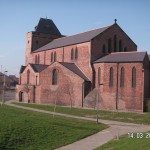
The churches of St Columba (1902) and St John the Evangelist (1865) are two of the remaining Anglican churches in the town center of Middlesbrough in the Archdeaconary of Cleveland and within the Diocese of York.  St Columba once served a residential area of some 28,000 people in the Canon Park area.  Today there are less than a thousand residents within the parish boundary.  It formally stood on the old Boundary Road, now it sits adjacent to Sainsbury’s Supermarket.

St John’s is situated at the other side of the town – at the corner of Marton Road and North Ormesby Road. When approached from the boulevard at the side of the Town Hall, St John’s stands out as an imposing and magnificent building – near a cinema and other leisure amenities in what has now become the St John’s Gate area of the town. Around 30% of the population of the Parish is now made up of ethnic minorities.

Both churches stand within the modern Catholic tradition of the Church of England – each seeking to offer dignified worship in their own unique setting. Each church has also passed resolutions A, B and C.

We hope you enjoy visiting our website – to discover a little more about our history and our current activities. You would also be very welcome at any of our advertised services, as would any enquiries regarding weddings and baptisms.



Divine Mercy at St John’s


Divine Mercy.

A Message For Today

By Fr Paul Kronbergs.


We seem to be living in extraordinary times.  Many Christian mystics appear to be receiving messages, which I think very much concern all of us.  The signs and things taking place in our world today indicate that we could very well be living in the end times.  On the Sunday after Easter there is a little known feast, which is celebrated predominantly by our Roman Catholic brothers and sisters.  This is the feast of the Divine Mercy.

I discovered this Feast while reading about a Polish Nun who died in obscurity just before the start of the Second World War.  She had received a special call to tell the world about God’s Divine Mercy and was given instructions to write a diary about this as it was revealed to her.  She was to record the message of Divine Mercy for the benefit of the world.  This Nun is St Maria Faustina Kowalska who was canonized by Pope John Paul II in 2000.   Jesus told her that rather than punish humanity for their wickedness he wished to heal them through His Divine Mercy, to heal humanity by pressing it to his merciful heart; to heal with His Divine Love.  St Maria Faustina was through God’s grace, totally immersed in God’s Love and Mercy.  She had many visions and one of these was a vision of the Divine Mercy Image, which she was told was to be painted and venerated.  In this vision, she described a breath takingly beautiful image of Jesus dressed in white; the fingers of his left hand touched his heart from which appeared rays of light projecting downwards, one coloured red and the other a pale colour.  These she was told represent the blood and water, which came from His pierced heart while he hung on the cross.  An artist was eventually commissioned to paint the image, but St Faustina is said to have been disappointed because the artist had not captured the beauty of the image of Christ she saw in her vision.

Jesus told St Faustina that now is the time of Mercy; a time for people to cry out to Him while they are still able to, because when He returns it will be the time of judgement and then the time of Mercy will be at an end.  Sacred scripture warns us about this time, the time of his return, that we must stay awake.  This is why I believe that Divine Mercy concerns all of us, and particularly those who call themselves Christian.  Our Lord revealed to St Faustina a number of promises and prayers associated with His Mercy.  One of the most important prayers is the chaplet.  which is recited on ordinary rosary beads.  The chaplet was revealed to St Faustina in a vision in which she saw an angel with a gloriously bright face, dressed in a dazzling robe.  This angel had been called to punish the earth as the executor of Divine wrath.  In her diary she wrote that she was terrified and prayed asking God for mercy, but found that her prayers were useless.  Then she began to pray with some words she heard being revealed to her, and seemed to come from the very depths of her soul.  She began to pray with a power that she had never experienced before; and as she did she realised that the angel was helpless and was unable to carry out the just punishment.  The next day St Faustina heard Jesus tell her to pray those words every time she went into the chapel.  He told her that this prayer served to appease Divine wrath.  She was later directed to use this prayer along with other prayers in a chaplet, which was to be recited on ordinary rosary beads.

When we say the chaplet we become united to Jesus’ sacrifice on the cross and appeal to God’s Divine Love for all people, that same love that is profoundly expressed in Our Lord’s Passion.  The word’s of the chaplet, “For the sake of His Sorrowful Passion”, refer not so much to the work of atonement, as to The Fathers infinite and inconceivable Mercy for us His children.  In saying the chaplet we are appealing to the Divine Love that was shown in Jesus’ Passion.

St Faustina believed that everything about us, our creation, our continued existence, our growth, our salvation, was due wholly to God’s Divine Mercy.  God told her that people were to call on His Divine Mercy and be healed.  Those who do call on the Divine Mercy will have sins forgiven, but are expected to live their lives reflecting the mercy that they themselves have received through God’s grace.  Devotees of the Divine Mercy experience God’s mercy as a reality in their lives.  Through the gift of grace they know that they have been called to be merciful people, and to live their lives performing Works of MercyWe seem to live in a very merciless world.   The capacity for evil in human beings and the horrendous things we seem prepared to do to each other doesn’t seem to shock us any more.  Surely we need the Divine Mercy more than ever.  There are so many damaged and broken people, and things just seem to get worse.

This was a message I wanted to take to those that I worked with on the streets, to God’s lost and broken children, but not only that, to proclaim God’s Divine Mercy to any who would be prepared to listen to me, because I believe that the Divine Mercy will wipe out sin and bring healing and wholeness to broken lives.

I would like to quote some words Jesus spoke to St Faustina: -  “My daughter, tell the whole world about my inconceivable mercy.  I desire that the Feast of Mercy be a refuge and a shelter for all souls and especially for poor sinners.  On that day the very depths of my tender mercy are open.  I pore out a whole ocean of graces upon those souls who approach the fount of My Mercy.  The soul that will go to confession and receive Holy Communion shall obtain complete forgiveness of sins.  On that day all the divine flood gates through which graces flow are opened.  Let no soul fear to draw near to me, even though his sins are as scarlet.  My mercy is so great that no mind, be it of man or angel will be able to fathom it throughout all eternity.   Everything that exists has come forth from the depths of my most tender mercy.  Every soul in its relation to me will contemplate my love and mercy throughout eternity.  The feast of mercy emerged from my very depths of tenderness.  It is my desire that it will be solemnly celebrated on the First Sunday after Easter.  Mankind will not have peace until it turns to the fount of My Divine Mercy.”  Those lost souls need The Divine Mercy they need His healing Love, we all do!

When I first read The Diary of St Faustina (Divine Mercy in my Soul), something extraordinary happened to me.  I can only describe it as setting me on fire.  I knew we had to set up a shrine and I knew that I had to tell people about what I had discovered.  We set up a shrine to the Divine Mercy in 2009 on Divine Mercy Sunday, and then began regular devotions on the second Thursday of every Month.  We sing the chaplet, listen to sacred music, and offer our intentions to the Divine Mercy.

In  2010 we contacted the Cardinal Archbishop of Krakow to ask if it might be possible to obtain a relic of St Faustina for our Shrine.  He very kindly supported our request and we were awarded a first class relic through the Congregation of Sisters of the Mother of Mercy, the convent of St Faustina.  In October 2011 Fr Stephen and I were invited to the World Divine Mercy Congress in Krakow Poland, which was held at the Divine Mercy Shrine.   I was asked to speak at the congress about our shrine and its development and while there we collected the relic of St Faustina. A copy of the address I gave at the World Congress can be found here.  The relic was formally and prayerfully brought into the church on the Feast day of St Faustina, which was very well supported by Christians of many different traditions.  Fr Stephen preached a very powerful and profound sermon that day.

Our shrine at St John the Evangelist Middlesbrough continues to grow as more and more people come to realise the importance of the message of the Gospel of Mercy and of the stillness of soul that it brings, and also of the many graces and blessings associated with this devotion.  I said at the beginning that these are extraordinary times.  I firmly believe that these are the end times, and that the church must come together, and that means Christians of all denominations because we are all one in Christ.  I believe that Divine Mercy can do this.  What I have noticed is that devotees of the Divine Mercy are all one in Christ because they all love with His Divine Love.  Divine Mercy changed me and I believe it will change you.   AMEN.


Submit A Prayer

Use this space to pray for yourself, friends, family or the world. Prayers submitted using the form below will be prayed by the clergy during morning and evening prayer. Prayers for those who have died will be included at the intercessions during the daily and sung Sunday masses.

Your Name

Your Email

Website

(optional)

Your Prayer

300 characters allowed

Contact Form

Any information entered and processed through the form below will be directly sent to the e-mail inbox of the Vicar, Fr Stephen Cooper.

Name

Email

Website

(optional)

Message

300 characters allowed


Should you wish to receive a reply, it is advisable that you enter your correct name and e-mail address in addition to your message, so that the Vicar will know who, and where to reply to. 

However, you may wish to speak to the Web Developer, Daniel Jones for any technical faults or queries. You may do this by sending an e-mail to: webmaster@columbawithjohn.org.uk

Greek Orthodox

Since 1999, a Sharing Agreement has been in place between St Columba`s and The Greek Orthodox Community of The Annunciation. An Orthodox Chapel (complete with Ikonostasis) is now situated at the east end of the church building (behind the high altar).

The Orthodox Liturgy is celebrated on the First Sunday of the month at 4.30pm.

The Columba Project

Since 2003, a “Drop In” centre has been developed within the community space at St Columba`s on Monday and Tuesday evenings from 7.30pm to 10pm.

It has become known as “The Columba Project”. It seeks to provide a listening ear to vulnerable young adults – and offers snacks and drinks.

The contact person for the project is Mrs Maureen Westerman: Tel. (01642) 270884.

Divine Mercy

We have a particular devotion to the Divine Mercy, and we meet on the second Thursday of every month at 7pm.

All are welcome to join us at  St John’s for a quiet time of reflection and prayer, in which we listen to sacred music, sing the chaplet and offer our intentions to the Divine Mercy.

Occasional Services

Both Churches celebrate the major Festivals throughout the year – sometimes with a joint service. A full programme of Holy Week Liturgies is also observed in each church.  St John`s holds its Patronal Festival on 6th May and St Columba`s on 9th June each year

Mass Times

The Church of St. Columba, Middlesbrough.

 Sunday
 9:30am  Mass
 Monday
 7:00pm  Mass
 Tuesday
 12:15pm  Mass
 Thursday
 12:15pm  Mass
 Friday
 10:45am  Mass
 Saturday
 9:30am  Mass


The Church of St. John The Evangelist, Middlesbrough.

 Sunday
 11:00am  Mass
 Tuesday
 7:00pm  Mass
 Thursday

10:00am             Mass
  Friday  

2:30pm             Shrine Prayers

Parochial Church Councils

St Columba`s PCC Officers:

Churchwardens:
Mrs Dorothy Ebdy
Mrs Carol Freary
PCC Secretary:
Mr David Atkinson
PCC Treasurer: Mr Colin Gray

St John`s PCC Officers:

Churchwardens:
Mr Andrew Leach
Mr Kenneth Pountney
PCC Secretary:
Mrs Gwen Fletcher
PCC Treasurer: Mrs Dorothy Waite

Organist for Both Churches:

Dr John Wilford


Twitter
Facebook
Forward in Faith
All Saints, Middlesbrough